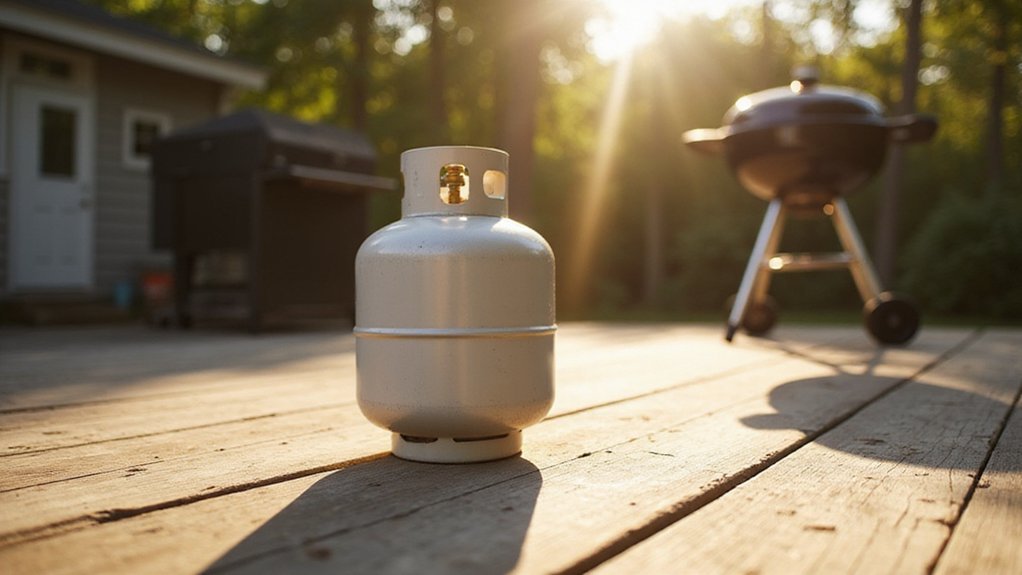
Wondering how long your propane fire pit tank will last during an evening gathering? A standard 20-pound tank typically provides about 8 to 10 hours of burn time on a fire pit with a 50,000 BTU rating.
Your actual time depends on factors like setting, wind, and cold. Keep reading to learn how to estimate your fuel needs accurately so your nights stay warm and bright.
How Long Does a 20-Pound Propane Tank Really Last?
How Long Does a 20-Pound Propane Tank Really Last?
A 20-pound propane tank typically lasts between 7 and x21 hours, depending on the appliance’s BTU consumption. For example, a high-BTU fire pit at 60,000 BTUs will empty the tank in about 7 hours. In contrast, a low-BTU camping stove at 20,000 BTUs can run for roughly 21 hours.
The actual runtime varies based on how much heat your appliance produces. Heaters and grills with higher BTU ratings consume gas faster, reducing the amount of time the tank lasts. This principle of heat intensity dictating energy consumption is similar to the way infrared sauna use operates at different wavelengths, much like the difference between the deep tissue penetration of far infrared and the surface-level warming of near infrared. To maximize your tank’s lifespan, perform regular maintenance—check for rust and ensure the valve cover is securely in place. Always inspect for leaks using soapy water before connection. Storing the tank upright in a well-ventilated outdoor area also helps maintain safety and efficiency, just as proper planning is essential for successful DIY outdoor projects.
Calculate Your Exact Burn Time With the BTU Formula
To calculate your fire pit’s exact burn time, start by knowing its BTU rating. First, identify the total BTUs in your 20-pound propane tank, which is approximately 431,820 BTUs (20 lbs × 21,591 BTUs per pound). This tank holds about 4.7 gallons of propane when full. Then, divide this total by your fire pit’s BTU rating to estimate the theoretical maximum runtime. For example, a fire pit rated at 50,000 BTUs per hour would last around 8.6 hours.
However, because engines and heat output are not 100% efficient, you should multiply this estimate by a fuel efficiency factor—usually around 85%. Applying this factor adjusts the runtime to about Ban_links 7.3 hours, giving you a more accurate expectation for real-world use. Just as choosing an efficient automatic pool cleaner extends your swimming season, this approach helps you go beyond rough averages and plan more precisely for your fire pit sessions. Knowing where to fill your propane tank is the next step to keeping your fire pit ready.
How Tank Size Directly Affects Your Fire Pit’s Runtime
Tank size is the primary factor that determines your fire pit’s runtime. For example, a standard 20-pound propane tank contains roughly 430,000 BTUs, providing about 8 to 10 hours of burn time on a 50,000 BTU fire pit. Upgrading to a 40-pound tank doubles that capacity to around 860,000 BTUs, which can extend your fire time accordingly. In contrast, a small 4.7-pound cylinder offers approximately 101,500 BTUs, running out in just 1 to 2 hours at high heat. Choosing a set with the right durable materials can enhance its longevity alongside proper fuel planning. You can maximize value by sourcing materials for a DIY propane fire pit using money-saving tips from a detailed guide. Just as a pool solar cover retains heat in water, ensuring your fire pit is protected from wind can significantly improve its fuel efficiency. Proper tank maintenance is essential to ensure consistent performance, and always follow safety guidelines when handling or connecting larger fuel sources for reliable, longer-lasting operation.
Why Your Tank Dies Faster: Weather, Wind, and Usage Factors
Weather, wind, and usage patterns significantly impact your tank’s burn time beyond its size. Cold temperatures slow propane vaporization, reducing how long your tank lasts. Direct sunlight can cause safety valves to trip, forcing shutdowns that cut your runtime. Rain makes your burner work harder, decreasing fuel efficiency as it compensates for damp conditions. Wind is a major factor—gusts blow heat away, requiring higher flame settings and wasting fuel. They also disrupt the flame, causing inefficient cycling and increased safety concerns since a struggling flame needs more attention. Your usage habits play a role too: frequent short burns waste energy on startup, while running the burner at a high BTU setting continuously burns through fuel faster. Additionally, leaving the burner on at the same setting when not actively in use adds extra burn minutes, draining your tank more quickly. Like any heat-based activity, optimal duration should be considered to balance enjoyment with resource conservation.
Pro Tips To Maximize Your Fire Pit’s Burn Time
To maximize your fire pit’s burn time, keep the flame at medium rather than high. Reducing the flame intensity can increase your burn time by approximately 40 to 50 percent, allowing you to enjoy more evenings from a single propane tank. Additionally, always use the thermal efficiency formula as a planning tool: divide the tank’s total BTUs by your fire pit’s BTU rating to estimate how long the fuel will last. This relies on the typical 430,000 BTUs in a 20 lb tank. Safety is also crucial—monitor tank levels regularly using the warm water test, and refill before the tank drops below 20 percent capacity to avoid unexpected shutdowns. Finally, remember to extinguish the flame immediately when you’re finished using the fire pit to prevent unnecessary fuel consumption.
Real-World Expectations: From Weeknights to All-Day Gatherings
A 20-lb tank typically lasts between 7 and 12 hours when used on low or medium settings during a regular weeknight. This duration makes it suitable for casual gatherings where flames are kept modest. However, during all-day events or when running a 50,000 BTU burner on high, the same tank can be depleted in roughly 5 to 7 hours. Keep in mind that actual fuel efficiency is around 85%, so these estimates are a bit optimistic compared to real-world conditions. Cooler parties can extend this time to about 6 to 8 hours, but wind and other environmental factors can reduce it. Just as with pool maintenance, where the step-by-step guide is crucial, knowing the correct chemical levels is equally important here. For longer events, always have a spare tank ready—it’s a key safety step to prevent running out while the unit is hot. Adjust your flame height accordingly to match the event’s duration, ensuring safe and efficient use throughout, as the cost per gallon for propane refills directly impacts how often you’ll need to fill up.