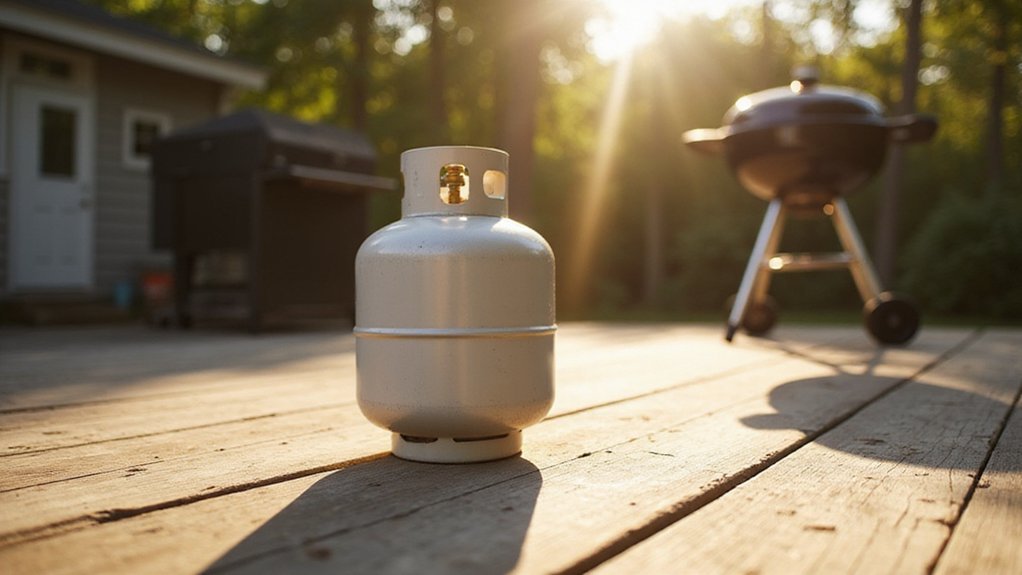
Wondering how to keep track of your propane supply without guessing? Your tank has a small, round gauge that shows the percentage of fuel left, which can help you plan your refills before running out.
Knowing how to read this gauge accurately means you’ll always stay ahead of low fuel issues.
Below, you’ll find simple steps to understand what your gauge reading really means.
How to Find and Access Your Propane Tank Gauge
To find and access your propane tank gauge, start by locating it on top of the tank. The gauge is usually beneath a protective metal dome or lid, which you need to lift straight up. For underground tanks, look for the dome on the riser cap. The gauge itself is the only small, round dial showing numbers and a pointer needle—ignore any larger PSI dials. Before reading, inspect the area visually and wipe away any heavy grime or condensation on the gauge face to see the numbers clearly. A successful reading requires gathering your tools and materials in advance. Check for any movement or damage in the needle, as this can indicate the gauge’s calibration status. It’s wise to consult your tank manufacturer’s instructions for any specific guidance or warnings before proceeding. Remember, your propane tank is only filled to about 80% capacity to allow for safe liquid expansion. This careful monitoring is similar to how one tracks infrared sauna sessions for consistent health benefits. After completing your reading, always close the dome securely to protect the gauge from dirt and weather.
What Do the Numbers on Your Propane Gauge Actually Mean?
The numbers on your propane gauge typically indicate the percentage of fuel left in the tank, not the exact gallons. Most gauges are calibrated to show a full tank at about 80%, not 100%, to account for vapor expansion. That’s why the scale often stops at 80 or 95 and not at 100%. A reading of 50% means your tank is half full, while 20% suggests roughly a quarter of the usable fuel remains, signaling it’s time to refill. Having a clear step-by-step guide for any home project, including preparing for a refill, can help avoid last-minute issues. For a large underground tank, it’s important to remember that the maximum fill is 85% for safety. If your gauge has values like65279;0-300, it’s measuring pressure in PSI, which requires different interpretation than percentage readings. Before starting a refill, ensure your DIY propane fire pit project is turned off and the tank valve is closed.
A Step-by-Step Guide to Reading Your Gauge’s Percentage
Locate your gauge and focus on the dial, which displays a percentage indicating how much propane remains in your tank. When reading the gauge, always look at the needle’s center point rather than its tip for the most accurate measurement. Round the reading to the nearest whole number, such as 40%. If the needle is between two marks, estimate the percentage accordingly. A reading of 80% signifies a full tank, providing enough vapor for safe and efficient usage. For accurate readings, check your gauge in good daylight to avoid shadows or shading that could distort the needle’s position. Understanding these measurement principles, similar to those needed for calculating pool chemical levels, ensures accuracy in various tasks. Following a step-by-step plan can help prevent errors in any DIY project.
Ensure the needle moves smoothly; a stiff or jumping needle can indicate issues with the gauge. To maintain safety, carefully lift the dome cover to access the gauge without applying force or pressure to avoid damaging components. Do not attempt to adjust or realign the needle yourself; if it sticks or jumps unexpectedly, contact a qualified technician for inspection and repair. Getting reliable results requires good testing technique, just as it does for other maintenance checks.
Before closing the dome, wipe away any condensation or dirt with a dry cloth for a clear and accurate view of the needle position. Once done, securely close the dome cover to protect the gauge from dirt and moisture, ensuring long-term reliability. Proper handling and periodic checks of the gauge help maintain safe and efficient propane use.
How to Convert Your Gauge Reading Into Gallons of Propane
To convert your gauge reading into gallons of propane, start by noting your gauge’s percentage reading. Since most gauges reflect the usable capacity already scaled to the 80% fill rule, multiply this percentage (expressed as a decimal) by your tank’s total capacity. For example, if you have a 500-gallon tank and your gauge shows 35%, multiply 0.35 by 500, which gives approximately 175 gallons remaining. Keep in mind that calibration variations can affect accuracy, so it’s best to consult your tank’s specific data for precise measurement. Using online calculators or printed charts for common tank sizes can simplify this process and reduce math errors, much like following a clear step-by-step plan for a DIY project, similar to having the right cleaning tools and instructions for maintaining your inflatable hot tub. Remember, readings above 80% may indicate an overfill, which could pose safety risks. Knowing the typical propane tank lifespan can help inform your usage and maintenance planning.
When Should You Schedule a Refill?
You should schedule a propane tank refill when the gauge reads between 20% and 30%. This range provides a safety buffer, ensuring you have enough propane before the tank runs too low and prevents interruptions in your service. Visually, if the needle enters the red zone or your appliance flames become weak and yellow, refilling should be an urgent priority. It’s also important to avoid letting the tank fall completely empty, as this can pose safety risks and make refilling more difficult. For example, introducing a new chemical to a system, like pool shock treatment, requires similar proactive planning to avoid operational issues. To maintain safety and proper system function, keep your tank on a stable, level surface in a well-ventilated area, away from ignition sources, similar to how proper ventilation and placement are critical in any enclosed heat environment. Planning your refill within this window keeps your propane supply steady and safe, and you must ensure its safe disposal if the tank is damaged or at the end of its life.