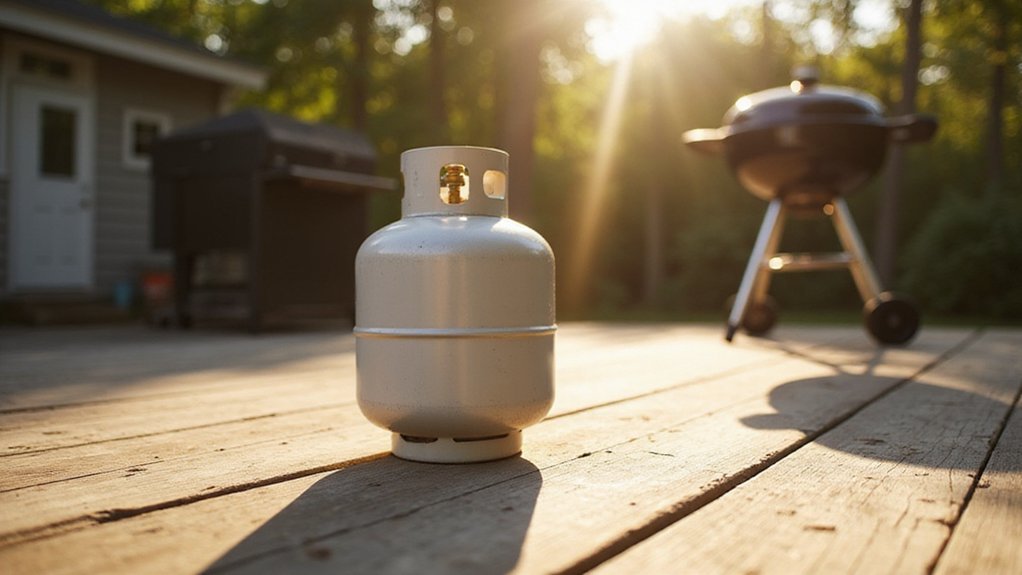
Worried about running out of propane in the middle of your grilling or heater session? Knowing how to tell if your tank is empty can save you surprises and inconvenience.
There are simple methods like checking the built-in gauge, using a hot-water test, or listening for a hollow sound when tapping the tank.
Read on to learn easy ways to keep track of your propane levels.
Check Your Tank’s Built-In Gauge
Your tank’s built-in gauge provides the easiest way to check its propane level since you can’t see inside. You’ll find this gauge under the protective metal dome on top of the tank. To check it, lift the cover and look at the small round dial. This is a percentage gauge, not a pressure gauge, and it measures from about 5% to 95%.
The needle indicates your current fuel level: 80% means the tank is full, 40% indicates half, and at 20%, it’s time to order a refill. To keep the gauge working properly, make sure the dome stays clean and free of debris, which ensures you can see the reading clearly. This regular monitoring is a form of preventative health maintenance for your equipment. A tank is filled only to about 80% capacity to allow for the safe expansion of the liquid propane inside. Managing your propane supply efficiently is crucial for uninterrupted use of your DIY propane fire pit, similar to how maintaining proper pool chlorine levels ensures safe and clear water.
Always follow safety precautions when handling the gauge. Never force open the dome if it’s stuck, and avoid using tools that could cause sparks. When the needle points to1920%, your tank is effectively empty, so plan to refill soon.
Do the Simple Hot-Water Test
You can perform a simple hot-water test to check the propane level when your tank lacks a gauge. Start by positioning the tank upright outdoors, away from any ignition sources. Use hot tap water, pouring it slowly down a narrow vertical strip on one side of the tank. After several seconds, run your hand along the wet strip. The temperature difference reveals the fuel level: the area where the tank feels warm contains only gas, while the cooler section indicates the liquid propane absorbing heat. The line where the warmth changes to cool marks the fuel boundary. This quick visual method allows you to estimate how much propane remains; a small cool area near the base signals a low tank, whereas a fully cool side suggests the tank is full. This entire process takes only a minute and uses common household items to prevent an unexpected interruption while grilling, similar to how knowing your fuel level can help you manage heating costs and efficiency for other appliances. Understanding a tank’s total lifespan is also crucial for safety and planning. For a more precise reading, you can learn to interpret the gauge’s percentage markings on tanks that are equipped with one.
Tap the Tank to Hear the Fuel Level
Tapping your propane tank can give you a general idea of the fuel level by listening to the sound it makes. Lightly rap your fingers on the side of the tank while it is upright and the valve is closed. A full tank produces a dull, solid thud because the liquid inside dampens vibrations, making the sound less resonant. As the propane level drops, you’ll notice a more hollow, ringing sound near the top, indicating less liquid. Pay attention to how the sound varies from top to bottom; a noticeable change suggests the liquid level is below that point. Keep in mind this method is only qualitative, since sounds can be affected by the tank’s material and construction. Considering the differences in upkeep and performance between various wellness devices, like an infrared sauna versus other options, it’s clear that the right tool depends on your needs. For tasks like draining your pool, it’s similarly useful to have the right tools and instructions for accurate results. Use it as a quick, approximate check rather than a precise measurement. This is similar to using qualitative methods like checking pool color for determining how much chlorine shock a green pool requires.
Weigh the Tank for a Precise Measurement
To measure your propane tank’s fuel level accurately by weight, start by locating the tare weight (TW) stamped on the tank’s collar. Place the tank upright on a suitable scale, making sure it’s disconnected. Weigh the tank and record the total weight. Subtract the tare weight from this number to determine the remaining propane. If the results are nearly identical, your tank is almost empty. Always ensure the tank is cool and stable during weighing to avoid triggering the pressure relief valve from heat exposure, similar to the thermal safety considerations in a DIY infrared sauna. For any maintenance task, having the right equipment and supplies on hand before starting is crucial for both safety and effectiveness. Having the correct fill valve tools ready before you begin ensures you can safely and securely close the tank after checking. Additionally, check all connections with soapy water after handling to detect any leaks—never rely on the propane smell alone. This method offers a precise measurement that surpasses the accuracy of simply tapping the tank to gauge fuel level.
Watch for Low-Propane Signs From Your Appliance
You can identify a low propane tank by observing how your appliances behave. Weak, sputtering, or yellow-orange flames indicate incomplete combustion caused by low pressure. If your appliance fails to light, the pilot light keeps going out, or ignition clicks but no flame appears, these are signs of low propane levels. You may also notice reduced performance, such as longer cooking times, lukewarm water, or a heater struggling to maintain temperature. Pay attention to the sound of gas flow; an absent hiss or inconsistent flow suggests the tank is nearly empty. These indicators are important safety precautions because malfunctioning appliances can pose hazards. Ensuring a safe fuel source is as important as building a proper fire pit when managing backyard hazards. Always follow proper storage procedures for your propane tank, even when it’s low, to maintain a safe environment.
Install an External Gauge for Easy Monitoring
Installing an external gauge provides a straightforward way to monitor your propane tank’s level continuously. To do this, verify that the gauge you select is compatible with your tank’s valve. Mechanical inline gauges are suitable for standard QCC1 valves on grill tanks, while smart ultrasonic sensors connect to apps for digital monitoring. Many propane refill stations also sell compatible gauges and can advise on installation.
Before starting installation, prioritize safety: shut your tank’s valve fully, disconnect the appliance, and work in a well-ventilated area away from ignition sources. For a mechanical gauge, screw it onto the valve by hand to avoid cross-threading, then reconnect your hose securely. The gauge’s position can be adjusted for optimal visibility after installation. After installing, slowly open the tank valve, and perform a leak test using soapy water at all connections. This safety check is a critical step, much like post-exercise recovery protocols that prioritize proper cool-down after physical exertion. When you eventually need to replace the tank, be sure to follow proper disposal protocols for the empty cylinder. This simple setup ensures you can easily keep an eye on your propane level without guesswork.